I love that everyone takes in a story and it's like, I get it from their position, wherever they are. And maybe in the end it makes me feel purposeful that my life helped someone realize anything. Because I didn't bear kids, but maybe my fruitfulness was
Speaker 2:just It's a different kind of fruitfulness.
Speaker 3:And it's like a thing that we have
Speaker 2:to think about as, you know, people of a certain age and the pressure and the fake clock that's fake ticking that they keep, like, lying to us about. But really, it's all we do the stuff we have to do or have these journeys. Mhmm. So like you said, to experience them, to teach them, to, like, plant seeds for other people. Because at this point
Speaker 1:What's the point in being human
Speaker 2:Yeah.
Speaker 1:If we're not impacting each other? If I understand the power of what I can create, then I can really, like, tailor it. And how we create, what we create, I created a perfect breast cancer.
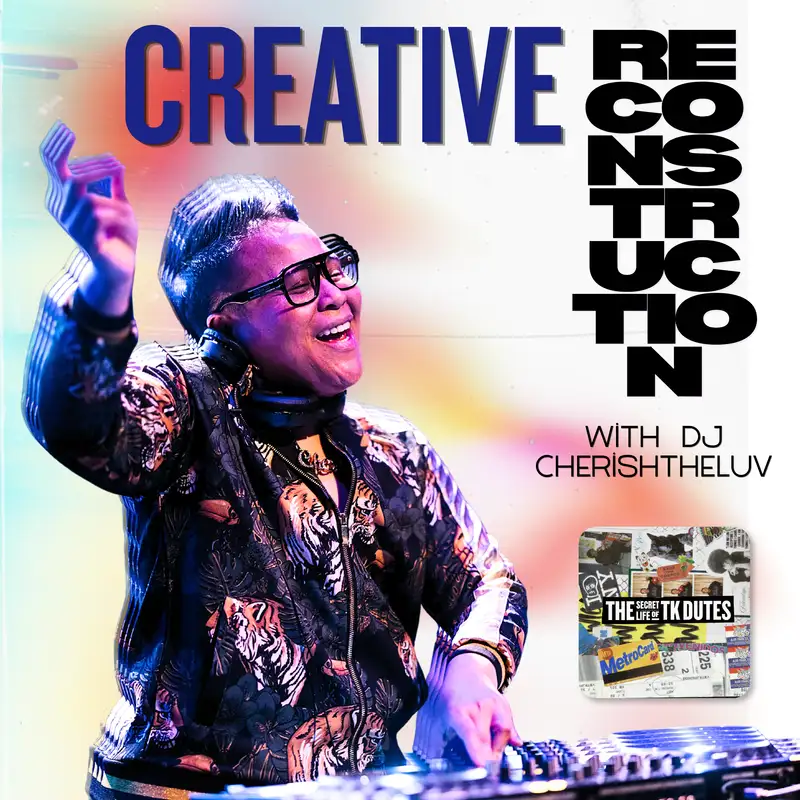
Speaker 3:That's DJ CherishTheLuv. And if you've ever watched someone just seem to overflow with creative energy, just be everywhere and everywhere you see them, they're doing something new, something bigger, something that makes you go whole up. How? That's been my experience watching her. She's a DJ who works with your favorite brands, streaming services, and music legend.
Speaker 3:She's the first woman ever to DJ on Broadway as coproducer of the Tony nominated Here Lies Love. She's been a radio host, a playwright and author, a DJ and artist in residence at Lincoln Center, and spoiler alert, since going into remission and being cancer free, she's been part of Memorial Sloan Kettering's melody study, contributing to the research of music's role in cancer healing. So I just had to know how CherishTheLuv stays so creatively alive, so creatively tapped in, how she keeps making, how she keeps building, how she keeps showing up with such an aura of gratitude and abundance even when it's hard. And what she taught me about creativity, about self awareness, and starting over, I didn't even know I needed to learn y'all. This is the secret life of TK Dutes.
Speaker 3:Now, before she became the multi hyphenate creative powerhouse that I just described, there was a version of Cherish I never got to meet. And the way she talks about that chapter of her life, that person she used to be, it changed everything for me.
Speaker 2:When you say you created the perfect breast cancer, what were the things that you were holding onto, or what got you there? Because also, I know from you sharing, like, online and stuff, just little things that you and I push it together. I'm just like, oh, that's a I call you a overcomer. And I'm just like, alright. That person been through some shit.
Speaker 2:And I also know that when you say shit, you're not saying it from a perspective that hasn't been considered a thousand percent. But to consider something a thousand percent, you have to have gone through something and you've talked about your breast cancer and you've talked about supporting other people. And I'm paying attention to my body as a woman, as a person, and especially these times as a black woman.
Speaker 1:Mhmm.
Speaker 2:Autoimmune diseases are, like, on 10 for us. This moment is critical for me.
Speaker 1:Mhmm.
Speaker 2:Because we're creating this shit all the time. So how do you see that you created that for yourself?
Speaker 1:So I can see it in three different ways. So let's start with the physiological aspect of it. I created it. They were my cells. Mhmm.
Speaker 1:I made the cells do because it's in my body. Right. So once you took ownership of that, then in my head, I'm like, I can uncreate it. So that was important for me to see. Cells were not implanted in me.
Speaker 2:Right.
Speaker 1:You know what I'm saying? So that's one thing, the physiological side of it. The psychological side of it was the psychological, emotional side of my breast cancer. I asked for it.
Speaker 2:Your psychological, like that's what your brain was telling you or your psyche.
Speaker 1:I hated my breasts. So they broke up with me. I hated my teeth growing up. Got into an accident, got new teeth. This is your precious, precious body.
Speaker 1:Your head and your your mind and your spirit and your flesh is connected. So if you think one thing here, it's listening. Listening. I didn't believe that. But then when I started to see, like, all these things unfolding, I was telling myself to get sick.
Speaker 1:I was not seeing myself as worthy of health. I was doing all kinds of things, but because in this society, the picture of health doesn't look like me, you know? And and the picture of health when we were growing up was like a third the width of my wrist. Oh, yeah. And the spiritual aspect of it.
Speaker 1:Just not having an idea of self worth and just like self love. As simple as that. Yeah. And protecting and, like, just valuing this bag of flesh. And when I was younger, I didn't realize, like, the toxic relationships and things that I was in that would affect the cells of my body until I saw it affecting the cells of my body.
Speaker 1:And in the year so I'm in my tenth year of remission now.
Speaker 2:Woah.
Speaker 1:Cannot believe. Because back when I was diagnosed in 2015, I was in support groups, and I looked up to idolize the women who were in their seventh year, eighth year, ninth year remission, and so few that were in their tenth, and I was like, I will never get there. I was like, I don't think I'm gonna survive. So these women were rock stars, and I surpassed it. So I was like, wow.
Speaker 1:In the group of all of these women that I spoke with, every single one of us that were diagnosed with breast cancer had a traumatic event, a job they hated, a terrible relationship they weren't leaving, all this toxicity that wasn't just environmental, was spiritual, just in their lives.
Speaker 3:Now she got me wondering if I would ever be able to turn my own grief, stress, anger and disappointment into something that worked for me and not against me. When do we decide it's time to let go of who we've been so we can make room for who we're becoming? Because as the elders say, if you don't lay down, the body will lay you down.
Speaker 2:When did you become aware? Like, when did the light turn on for you? And then when that light turned on, what were the tools that you grasped for to, like, shift your mindset and your self worth and push into the creative zone?
Speaker 1:When I had to recreate myself in 2008 after a head injury, this is such an important lesson. Here I was on vacation, My husband then and I, we had long boards and we were in Sweden and we get to a hill. At the top of the hill, there's this voice that says, this hill does not have your name on it. It was as clear as this. Yeah.
Speaker 1:That I know now is, like, my intuition or future me. And then the other voice kicked in and said, no. We have to hurry because I have stuff I gotta do in these computers. Go down the hill. Of course, no helmet.
Speaker 1:I see the hill. Blank. All I see is grass. And I'm just, like, sitting there like, wow. And I turn this way, and I see the hill this way.
Speaker 1:And I see my ex husband, then husband, running, but, like, slow motion. And I see him trip, and he's in the air falling slow like this. And I was looking like, woah. I looked down at my hands and they're pooling up blood, and I realized the blood was coming from my face. So I had, he said, saw me lose balance, must've hit a rock.
Speaker 2:Yeah.
Speaker 1:Hit my head three times, my teeth shattered, hands torn up, tore up my lip, lost these teeth, broke my shoulder, my knee, and tore this up. I was so physically banged up and in the hospital, emergency rooms and so on, they forgot to scan my head. So I had a severe concussion. I was diagnosed eventually with mild traumatic brain injury in 2008. For the next two years, I didn't work, I didn't pay tax, I didn't understand what was going on.
Speaker 1:I had to go to therapy to do occupational stuff, like take a bath again. And eventually I started to wake up from the cloud of a concussion. So this post concussive syndrome that I had left me with this joy of, I don't feel any pressure. And all of a sudden, things started coming And I go to this side of my studio, and I see three computers. And I was like, oh, dust on them.
Speaker 1:I opened one up. Emails in Microsoft Outlooks are coming in. 7998 emails. And I was like, what? And I didn't realize I wasn't working.
Speaker 1:Because you don't know what you don't know, especially when you're recovering from an injury, illness, whatever. But I was injured, and, like, only a few people understood and knew what had happened. So I start to not understand my own life. I go to a wedding.
Speaker 2:Mhmm.
Speaker 1:And this woman comes up to me. I go to shake her hand. And she was like, why are you shaking my hand? It was my aunt did not recognize her face at
Speaker 2:all. Woah.
Speaker 1:My mom who has white black hair. Yeah. And I started to realize, oh crap, my brain's not working. And I realized, I don't know what I'm supposed to do in this life, and slowly went into this spiral. Okay.
Speaker 1:Where I was like, I think I need to just die. Like, started seeing therapists, cognitive behavioral therapy to just try to like understand what I was processing, doing all these tests, and just feeling like I'm stuck. And feeling stuck in your own head is one of the most helpless kind of things because you can't really explain to someone else how it feels and how lost you are because I am born with a natural cute smile. So I could be smiling, but inside was super grieving something. And I also didn't connect with how to explain that until these years.
Speaker 1:So in the point of my giving up, here's the turning point, the tool. I had turned on the radio and I hear this one song, Paul Anka, lonely boy, I'm just a lonely boy. I have a memory of camping. Now this was a time when you asked me what schools I went to, I couldn't remember. But suddenly, I had memories of camping and my cousins and childhood coming in by listening to music.
Speaker 1:So that's when I started to download everything I could on Napster, on LimeWire, and listen to music desperately waiting for more memories to just flood in so I could understand who I was and create who I was gonna be. So everything that was on my wall, the diplomas and everything made no sense to me. So I was like, I don't know who I am. None of this even I don't know how to design. I don't know how to write.
Speaker 1:I don't know how to do any of this. And I was thrown into music.
Speaker 2:And this is the beginning of DJ CherishTheLuv?
Speaker 1:This is the beginning of why I even started to care about listening to music. I started to then go into, like, coffee shops and playing music from these iPods and say, can I just play music? And they're like, you want a DJ? I'm like, no. No.
Speaker 1:No. There's another DJ. I thought, Cool, you want a DJ? And I was like, Yeah, what do you want to be paid? And I said to them, Just pay me a penny a night.
Speaker 1:It's for my therapy. They're like, Okay, the prettiest penny from your register. I have an unbelievable pennies from these nights. So eventually, someone was like at one of the coffee shops in East Village, let's pay something. How about $25 Okay.
Speaker 1:For the evening? In that crowd was this woman who was like, could you DJ my wedding? And that was my first that was my first quote gig. I had no gear. And she said, I'll pay 750, and that blew my mind.
Speaker 1:Yeah. So I bought, like, a controller and a subwoofer. So that was the start of it. And then because of the way I was traveling through music and everything, was communicating, not even consciously communicating, then I was pulled into all these things that then brought me onto a professional DJ journey Okay. Which is, like, wild.
Speaker 2:So you're getting now, like, at that point, you're getting to learn on the job. Totally. Totally learning on
Speaker 1:the job.
Speaker 2:And heal on the job.
Speaker 1:And what a pleasure. Because if you were to sit me down and tell me we're gonna, like, do this gig, I couldn't even, like, picture what that would look like. Mhmm. Because it was just for me. And there was a point where I realized now I wasn't DJing for anyone there.
Speaker 1:I wasn't playing music for anyone there. It was always for me. Now in my career of now, like, I don't know, thirteen years getting paid to do it, there was a point midway where I started to do it for the people. And I was like, this is different. There's so many times in that journey that music was like, wow.
Speaker 1:Yeah. There was one patient I worked with where she was so far gone and on the verge of passing away that one of the nurses says, don't play music, don't keep her here anymore. I mean, bringing music to hospice patients, folks who are dying. Wow. What that does, it's so powerful.
Speaker 1:So there is a journey and that tool for me to then recreate myself and to understand who I was in that point moving forward was music.
Speaker 2:So how do you, as a professional now, how do you maintain that, like, healing power? That's such a great question.
Speaker 1:I try to stay as honest as possible to myself. When I don't like myself, I don't create.
Speaker 2:That's real.
Speaker 1:When I am honest with no matter what state I'm in or however I feel, I'm really happy to create and put things out there. And again, like, I realize how powerful I am in my creating. Any moment of calm you can create for yourself is a real gift. And if that's even ten minutes in a day
Speaker 2:I'm learning to sit with that.
Speaker 3:You may have heard me say it before, but I'll say it again. If it's not a hell yeah, it's a no. And you'll feel it. Pay attention to what lights you up. Pay attention to the heat rising in your chest, the subtle churn in your gut, or the thing that makes your heart skip a beat.
Speaker 3:Once you know what intuition and honesty feels like in your body, it's hard to go back. Your body will give you the blueprint on what to do next. And chances are, it's the opposite of what society tells you to do.
Speaker 1:So I came to this realization during my acute breast cancer years. It was very interesting. But there are only four ways that you can die. By accident Mhmm. By active nature.
Speaker 1:You know, your body dies, whatever.
Speaker 2:Yeah.
Speaker 1:By someone else's hands or by your own. But there was only one way I realized that I could live, and that was my choice. And when I sat there with that, I was like, even when I wasn't liking what I was doing in my life, was still choosing one.
Speaker 2:Chose it.
Speaker 1:And I was still choosing it. I was like, that was actually one of the turning points for me to start creating. Yeah. And to create, like, the life that I wanted.
Speaker 2:Because it's like the only thing you have control over.
Speaker 1:Yeah. But we aren't, I don't know about you, but I wasn't taught to listen to myself. So I'm like, what is that about? Whatever it is from the way we grew up. And then I knew I can make new decisions too.
Speaker 1:Not rectify, but maybe just make better. Everything is amused. If you think about it, everything, every bad situation was a muse to create another situation, another living experience. I think that if we could just, like, remind people that you have a lot more power in how you feel about wherever you are, then things might be okay.
Speaker 3:My life is my muse. This show is a choice and my portal to healing. I have to believe that doing me will lead to the creative abundance that I seek. Now, say it with me and feel it in your body. My life is my muse.
Speaker 3:I have to believe that doing me will lead to the creative abundance that I seek. Everything I do is a choice and my portal to healing. Choose wisely. If you would like to see, yep, I got video, the raw full conversation between me and DJ CherishTheLuv, become a contributing member of my Patreon. We get into religion, our queerness, how that shows up for us, and how making room for our creativity opened us up to love.
Speaker 3:For the full conversation, join us at patreon.com/secretlifeoftk. K. I would love to hear from you. So call me on the secret lifeline at (929) 551-4363. You can leave me a message or text me even.
Speaker 3:That and a five star rating and review wherever you listen to the show helps because your experiences help other people feel like they're not alone. Be loud and proud about loving this show y'all. And thank you, DJ CherishTheLuv for keeping it super real with us and showing us there's always something more on the other side. The Secret Life of TK Dutes is hosted and executive produced by me, Keisha TK Dutes for Philo's Future Media. This episode was produced and sound designed by the illustrious Mike Brown, and you'll get to hear more of his work in upcoming episodes.
Speaker 3:With post production support by C, aka AG Trap House on IG. Next stop on our journey, we crossed the border, and I start to put the pieces of this life together further away from everything I've ever known. Let's go.