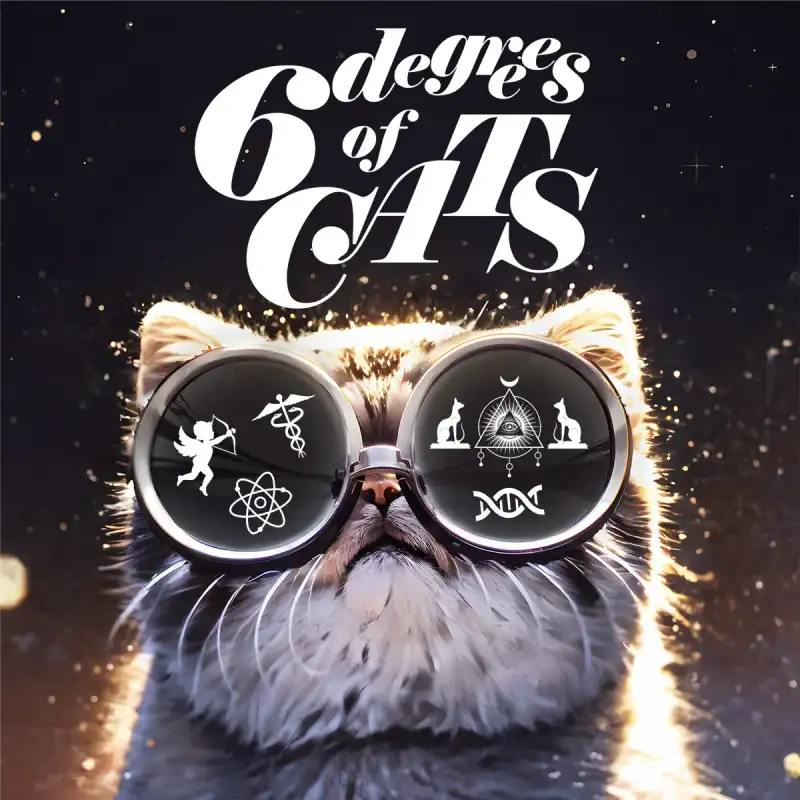
Yo. It's TK. Check out this message I got from my friend Zee after she listened to episode three, A Season of Loss with our guest, Ta Witty.
Speaker 2:You know, TK, I was thinking about getting a cat. So I got this sublette, and it was a deal because there was cat care involved. I had to take care of this cat for three months, and right now, I'm living with a cat. And it ends in two weeks, and I'm already sad. I don't wanna leave the cat.
Speaker 2:Like, cat is so ador just the companionship that you talk about in the podcast, it really it resonated. And it's like no other companionship. It's like no other connection. Yeah. We have great amazing human connections, but it's just a different level of like intuition and and I just feel like you said it in such a good way on the podcast.
Speaker 2:And then I was like, oh my god. I can't get a cat because I'm gonna be so sad. How am I gonna leave the cat anywhere? What am I gonna do when the cat dies? Like, I started having all this anxiety around like, oh my god.
Speaker 2:Like, I can't get a cat because it's gonna be so sad when the cat dies. But then when I listened to your podcast, it just it just put me over the edge, and I was like, it's worth it. Like, it's painful and deep and distressing and upsetting when your pet dies or when your, like, like, companion dies. Like, it is. And I loved what your guest said, which was you have to start thinking in new ways.
Speaker 2:Like, it's the big like, grief is a doorway to something new, to, like, newness, and we're constantly doing that. But I think we suppress the grief part a lot and I think having that experience helps us feel things fully and I think the whole point of being alive is to feel things fully so thank you for that because I am definitely gonna get a cat now.
Speaker 1:Nada's out here changing lives. Oh my gosh. I hope that you are so happy with your new furry family friend. Let me tell you though, I really, really, really love getting messages from y'all. And you can always feel free to leave me one anytime at nine two nine five five one four three six three.
Speaker 1:Now, what makes this show The Secret Life of TK Dutes and each episode particularly special are the producers. Each one is perfect for the episode they produce because of their background, their cultural experiences, and because, real talk, I trust them. And since we're getting to that point in the series where some of our producers have shows of their own, I wanna share them with you. So with all that in mind, I have an excerpt from producer Amanda B. Nazareno's cat themed culture, history, and science podcast, Six Degrees of Cats.
Speaker 1:It's fun. It's hosted by Amanda. It's produced by Amanda. And what I love about it is just when you think you know where it's going, Amanda looks deeper. In her season two finale, she asked this question.
Speaker 1:Our feline fictive kin, are Cats full fledged family? Say that six times fast. And I think this is a perfect share for our listener friend Z and anyone contemplating getting a new family member of their own.
Speaker 3:You were super tiny and had just been picked up off the street by a truck driver. Turn the page now. He brought you to Broadway Animal Clinic, and you were so cute and so tie What do you mean you've heard this before? Well, fine. I guess we're done with the Snuggles memory book for now.
Speaker 3:Such a typical teenager. Welcome back, cool cats and cat allies alike to six degrees of cats, the world's best and only cat themed culture, history, and science podcast. Not a day goes by where I don't wonder what is going on in the walnut sized brains of my little children or my co executive producers, Binky and Snuggles. Partly because we can't speak to each other, true, there's body language and tells. You know, I've read all the books.
Speaker 3:The ears, the tails, the fur raised, the vocalisms like hissing and meowing. But what goes on behind Binky's big golden eyes when his pupils dilate? Did he just remember something from his childhood Or Snuggles. I can definitely sense the PTSD, and it breaks my heart. As well as the fixation on cardboard.
Speaker 3:What's up with that snug? Might it have to do with Snuggles' last minutes of her mom and siblings before she was extracted from the side of the road that fateful day and adopted Wait a minute. It just occurred to me. Snuggles, Binky, and I don't know who our biological parents are. We're all adopted.
Speaker 3:And in this season two finale of six Degrees of Cats, family is the watchword. We're gonna take a closer look at family and, of course, these little adoptees we brought into our homes, hearts, and our families. So buckle up, listeners. It's time to get a little more personal. In 2012, researchers found that there were more American households with pets than kids.
Speaker 3:Meaning, there are more people in this country whose children have fur, feathers, or scales than, human skin. And yet, try telling that to HR if your time off policy precludes pet care or, heaven forbid, pet bereavement, or justifying your cat's photo in your wallet to your college bestie's flavor of the month at happy hour, who is that guy that decides it's comedy hour and you're the sucker who happens to be a lady with cats sitting right next to him. And he has a YouTube channel. Great. Don't even try it with the US Census Bureau or the IRS.
Speaker 3:Neither count pets as dependents. I may or may not speak from experience. What was I saying? Right. Family.
Speaker 3:That's a word that either sends shivers down your spine, delight in your heart, or perhaps something ambiguous or in between. What's that thing Trotsky said about families? Maybe you feel like you have family. They just aren't related to you, or maybe you feel like you just haven't found them yet. Either way, there's no escaping the impact of family or lack thereof.
Speaker 3:According to the UN, family is the fundamental group unit of society, and claiming a family or being claimed by a family is a huge part of our identities. I guess that's why there are so many plays, dramas, songs, and stories about families. The more I say the word family, the more I realize just how amorphous that word is. Here on the human side of things, it's said casually in conversation. You know, cat family, hey fam, that kind of thing.
Speaker 3:So let's, dig into the word. There's the family, capital t, capital f, You know, the mafia. Or cults, be they corporate or religious.
Speaker 4:We are like family here.
Speaker 3:Run. Don't walk when you hear that in a job interview. Or on the street. Seriously, true story. The Family International, warmly known as the children of god cult, repeatedly tried to recruit me as a member when I lived in Tokyo.
Speaker 3:I have no idea what about me, screams, nonconformist who is open to weird stuff. Whatever. Oh, and, of course, the family, as in parents, kids, aunts, uncles, cousins, the court jester, the family frog. Since this word has a variety of applications these days, let's get on the same page here. As in, what's on the page when you look up f for family?
Speaker 3:Here it is. Oh, etymology. I love bugs. What's this say? Brian, take it away.
Speaker 4:Family is from late middle English, and also from Latin, familia. For household servants or family, from famulus servant. To denote the servants of a household or the retinue of a nobleman.
Speaker 3:Well, now, that certainly adds a spin on the origin. As for the definition here
Speaker 4:A group of people consisting set of parents and their children, whether living together or not. In wider sense, any group of people connected by blood, marriage, adoption, etcetera.
Speaker 3:That's more or less what I expected. And, you know, it leaves a lot of people out. What defines those connections? How come it's just people? Who came up with this anyway?
Speaker 3:I am not the first to notice this. Heck. There's a whole field of research dedicated to studying the family.
Speaker 5:Human development and family studies at the time science now.
Speaker 3:And I was fortunate to have consulted one such expert to understand the tiny telenovela of our lives, La Familia, the family.
Speaker 5:So my name is Carol Johnston. Human development and family science is what my master's and PhD are in. I'm on faculty at Kansas State University in the department of applied human sciences. I started looking at what happens when family changes, not necessarily the family structure itself, but is it changing a lot? So is there a lot of turnover in who's in the household and how that affects children over time?
Speaker 5:And that to me became very fascinating. It is really the core of what I do today.
Speaker 3:As doctor Johnston's work alludes, the concept of the family as two parents and kids, etcetera, is up for serious reexamination. To start
Speaker 5:Think about the different family structures. Like, I think even today, people would say that the ideal family structure is a two parent biological family home. Right? And that's actually not the case. Before, you know, we have what we think of as the nuclear family, it could be that grandparents or a grandparent was really the head of the household, or it could be that the parents who are kind of what we would call now the sandwich generation were the head of the household.
Speaker 5:Thanks,
Speaker 3:doctor Johnston. This was true in the seventeenth century when the colonists from Europe arrived on North American shores, then known as Turtle Island. Those folks quickly stole from those 50 to a 100,000,000 people who called this continent home at the time that are now collectively referred to as native Americans, who they then drove, trafficked, or murdered off the land. And then got to work harvesting the riches of this new world through real estate development, trade, and, of course, agriculture. And it's at this point where I think the genesis of the nuclear family story we're told can be traced.
Speaker 3:Down on the farm, doctor Johnston takes the floor.
Speaker 5:At the time, multiple generations of families were living basically on farms and helping out in whatever way they could. When they were working on the farm, for example, children would go from children very quickly to helpers. They had more children because the more children, the more help that there was. And the industrial revolution really was one of the biggest movements away from that larger extended family to the smaller family that is more prevalent today. A lot of that had to do with people moving to big cities, getting jobs that weren't on the farm and things like that, and being able to really have the money to support a family without being on the family farm like had been in the past, where adults could make a living in cities doing nine to five work essentially.
Speaker 3:The good old days where you weren't always on
Speaker 5:Actually, I don't think it was nine to five at the time. Was more like twelve hours a day. Never mind. Interestingly, the average age of marriage also dropped during that same time, the late nineteenth and early twentieth centuries, but has increased in recent decades. So what we saw was when men and women were going to the city and they weren't with their families, they were alone.
Speaker 5:And so they started marrying earlier instead of later.
Speaker 3:Fascinating. I thought that would lead to people delaying marriage. What else transformed?
Speaker 5:As we saw smaller families and started to seek this developmental period of adolescence that wasn't always there.
Speaker 3:Adolescence. From workers in the house to slackers Some cases. And eating a lot, mood swings, making messes, getting away with it. And, of course, they're always around if you need someone to give an unsolicited opinion. That kinda sounds like my cats.
Speaker 3:So about this industrial revolution, you know, Ford's Model t car and the introduction of the assembly line manufacturing process, which kicked off the huge global supply chain. This transformation relieved US families from the hard work of being basically a one home factory, making everything from food to clothes to homes by hand from scratch. You'd think this whole mass production system designed for surplus would then allow for everyone to be comfortable and have food and not suffer through the winter worrying about how to keep a roof over their head and the heat on, You know, so people could rest. To live like a house cat. Well, you done thought wrong.
Speaker 5:The shift really favors the wealthy and really hurts the working class in a lot of ways. We don't have a lot of social resources for families in The US. We don't have universal childcare. It just doesn't give parents and women the option. Right?
Speaker 5:I have a friend who his wife, it is cheaper for her to stay home with their children than for her to work because childcare for her to work was more than her salary.
Speaker 3:What happens when you don't buy into that and choose to be, say, a childless woman with a cat?
Speaker 1:I can tell you what happened for me. I've been living my best life, but you can head over to six degrees of cats podcast feed to hear what Amanda uncovered about how society sees us and the new ways we're creating family. Follow this award winning podcast at six degrees of cats on IG and keep your ears peeled for a certain someone, me, featured in another episode beyond Taylor Swift, who are cat people? Spoiler alert, it's me, but it gets deeper than that. Anyway, thank you Z for sending a voice note and thank you Amanda for sharing and making Six Degrees of Cats for us to enjoy.
Speaker 1:I would also like to give a big, big, big shout out to the Cat Museum of NYC for sharing our episode of The Secret Life of TK Dutes in their pet loss grief guide. Thank you so much. Next time you hear from me, I check-in with friends of mine on their own secret life journey. This special bonus was produced and brought to you by me, Keisha Duesse with audio help from SEA. Thanks for listening.