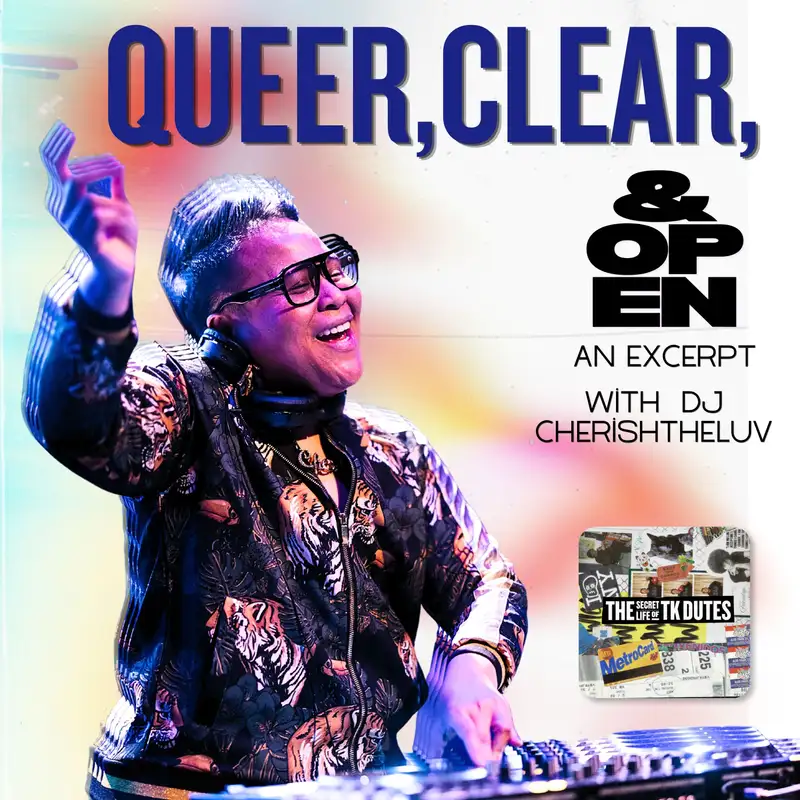
You might be queer and you don't even know it. To me, living beyond societal expectations, that's queer. Living up to all of the potentials inside of you, that's queer. Pushing back against the system, whether they be societal, familial, or generational, that's queer. So I went back to my conversation with DJ CherishTheLuv.
Speaker 1:She's an artist, a producer, an author, and so much more, who after experiencing a traumatic brain injury and breast cancer, she couldn't get back to her old life nor did she want to. She was on a mission to create a new life, a life more honest about who she truly would become and is still becoming. But as we celebrate pride, I wanted to share an additional excerpt from our conversation because it reminded me of the great Audre Lorde's teachings and this quote. Queer not as in who I sleep with, but queer as in the self I make, the life I create, and the resistance I bring to the systems that oppress me. Welcome to The Secret Life of TK Dutes, a queer, clear, and open side quest with DJ CherishTheLuv.
Speaker 2:I'm really good at, like, making logic out of things in my life and seeing the math and the formula, like, how I got here. But the things I can't understand have got to be older than me and my mom and my grandma.
Speaker 1:Mhmm. And it comes through. Mhmm. And like, you know, I don't know, I read some science thing that's like, we we were there before we were there, right? Because we weren't inside our mothers.
Speaker 1:Our mothers were inside our grandmothers. Sure. Unrelated to whoever, you know, the other half of the chromosomes and shit. We were already there, and so all of that stress and that pressure and those, like, learnings, like, we have to deconstruct. Sure.
Speaker 1:In utero stuff is real.
Speaker 2:Yeah. Right? Whether it's, like, hormonally, chemically, environmentally, all that in utero stuff spiritually
Speaker 3:Mhmm.
Speaker 2:Is real, the stuff we pass on, which is what actually a really, really big piece of my understanding, my creativity, and my output. Yeah. So people perceive me, as you mentioned, like, putting out a lot
Speaker 1:Yeah.
Speaker 2:Doing a lot.
Speaker 1:Mhmm. Oh my gosh.
Speaker 2:Yeah. Always felt like
Speaker 3:I You so busy.
Speaker 1:Yeah. And I'm like, busy?
Speaker 2:Like, this is regular. Like But so I asked myself, why is this my regular? Mhmm. Because I do talk to and their day looks very different.
Speaker 1:Yeah.
Speaker 2:Like, they focus on, you know, one or two things, not 13 or 21 things. Yeah. You know, so I was like, okay, so why do I feel like, and I've thought this so many years of my life, why do I feel like I'm more than one person? Like, why do I feel like I have to accomplish the amount of more than one person? And they asked me this I asked myself this over and over and over again.
Speaker 2:So this is a trip because I don't talk about this often because I I only talk about this to folks who are queer enough, clear enough, and open enough Let me
Speaker 1:write that shit down.
Speaker 2:To say. Put that on a shirt.
Speaker 1:Queer enough? Are you queer enough?
Speaker 2:Clear enough? Open enough? No. Tell me now. Something that's gonna blow your mind.
Speaker 2:Mhmm. Since I was a kid, I always felt like I wasn't just a girl. And I didn't feel like I was a boy. I didn't feel like I was an in between. I threw through my just feeling my body, I knew I was more.
Speaker 2:Yeah. Later on in life, I got the words for it. Yes. But this is what happened. Growing up, I had I have an older sister.
Speaker 2:Mhmm. She's the gay one. Officially. She's like yeah.
Speaker 1:She's the one. Everyone knew early.
Speaker 2:Everyone okay. You know, we saw Katie Long on TV, and we're like, you. We're like, she's the gay one. I was the cute in the middle kid who was gonna, you know, like, have a husband Right. Do all the things.
Speaker 1:Fulfill all the dreams. Mhmm.
Speaker 2:Saying that my brother was gonna do what the youngest boy does.
Speaker 1:Just Literally whatever he wants. Whatever he Mhmm.
Speaker 2:I always knew, and I always felt like there were other referencing voices in me. Not like I heard voices, but I felt like there was more. Like, I have a very complicated way of thinking ever since I was a kid. So Mhmm. People called me a tomboy sometimes.
Speaker 1:Mhmm.
Speaker 2:And people called me girly sometimes. So I was like, I guess I'm just whatever. Yeah. But I was always girl. Right?
Speaker 2:Growing up in the early eighties, my like, the the gay scene was like I remember it was LGB. Lesbian, gay, bi. Then all of a sudden it was LGBT. Mhmm. And I was like, oh, okay.
Speaker 2:We're learning about this. And then it became LGBTQ. And I was like, oh, these people are this way. Fast forward Yeah. Thirty years later, and here I am teaching with a bunch of young kids who have way more language than me.
Speaker 2:And they're identifying as nonbinary and all these things. And they're like, yo, you're one of us. I'm like, what what do you mean? They were clocking me. Oh.
Speaker 2:They knew what I was carrying was more they than any one binary thing because they could see the gender expansiveness of me.
Speaker 1:Yeah.
Speaker 2:And that's what I didn't know the words for growing up. Woah. I was like, oh, that makes sense. Yeah. I'm she, her, they as fuck on my best days.
Speaker 2:And I was like, that makes so much sense, and I don't know why. Yeah. I just feel like there's like more than what people know or I know. So here's the trip. Alright?
Speaker 2:I always wondered why. There was a year in between me and my brother, age difference, and four between me and my older sister. I was like, Why is my sister so much older? My mom has a stroke. My mom goes through her healing process.
Speaker 2:My mom starts to recover.
Speaker 1:Okay.
Speaker 2:I start to say, I need to have more conversations with my mom because I almost lost her. Yeah. In these conversations, she just puts out a truth Yeah. That she lost two babies between me and my sister. Wow.
Speaker 2:And those two babies entered me. And I had, through my life, been exercising their potentials and mine as well. Sheesh. So that vagueness made so much sense. Yeah.
Speaker 2:And I was like, you know, the folks who are very conservative, who are like this woke shit? I'm like, why wouldn't you wanna be woke? You wanna be asleep? Like, the opposite of being awake. I don't understand.
Speaker 2:All this woke shit, all the nasty stuff they say about, like, queer folks and what they're calling Alphabet kids now, like, GBT, whatever. I'm like, wait a minute. It's not about throwing something away. It's a biggerness. It's a beauty.
Speaker 2:Then I started to look at what that acronym or initialisms became. The LGBTQ became LGBTQIAAP plus plus, and I realized I was in there.
Speaker 1:Yeah.
Speaker 2:And I was like, Airman, yeah.
Speaker 1:Yeah. Oh my god. And I relaxed. And how did that I just guess, like, coming to that point of relax and realization and
Speaker 2:One of my DJ students who, non binary, totally nervous kid, felt really safe with me. And I was like, I need to relax in exactly what I am, and not try to say, In this society, I'm supposed to carve myself into a certain way. And I relaxed, just letting myself take its shape, you know, like do whatever I was going to do, even if it meant expressing whatever manifestation of illness that I created in that timeframe. Then I would heal it. You know, just like figure out my way to feel better and do better for myself.
Speaker 2:It is really incredible when you look back at your whole life and then see what you've created is today. Yeah. I mean, like
Speaker 1:This day right here.
Speaker 2:Everything Yeah. That you've done and experienced creates today. So if you think about that, then you have to naturally start thinking, oh, what do I wanna create ninety days from now in myself? And if you look at it that way, it's so beautiful, actually. Because you're not a victim to anything if you wanna look at it this way.
Speaker 1:Mhmm. What about people? Because I feel like because we're talking and we know what we're trying to say to each other.
Speaker 2:Mhmm.
Speaker 1:But to the person that's listening and they're like, I call bullshit on all this, like, I created my own illness and blah blah blah, because I, you know what I'm saying, know, you know, it's coming and I wanna ask you, like, just like, what about that person? Like, can they, like, realize or turn their wrap their head around some of some of this stuff, even a little bit to just kinda, like I don't wanna say accept. But somebody's calling bullshit on us right now. What would you say to them? I
Speaker 2:hope their moment of realization isn't too harsh. I think people come to their own oh moment whenever they do. Yeah. But there's no doubt on my mind that hearing it and having that argument in that person's head about is this bullshit or not is not already creating some sort of awareness that maybe I could think a different way.
Speaker 1:Yeah.
Speaker 2:You know? Like, maybe there is something more than what I'm thinking. Unless they're really locked in and just, like, really want to be angry, then that's a whole other thing.
Speaker 1:I was thinking about, you know, and just to, like, go back to some of the queer talk. That's the name of the show,
Speaker 2:Queer Not
Speaker 1:because, you know, like, oh, yeah, this is the deconstructing. I think for me, I think you were talking about your realization of your non binaryness, right, and people clocking you. I think for me it was always more sociopolitical first, before because even like I just was like looking at the world always, even as a kid, maybe that's also a little bit of what folks are calling neurodivergent now, and neurospicy or whatever. Like, I'm looking at the world and I'm just like, that's dumb. That's dumb, that's not right, why can't we just be nice to everyone?
Speaker 1:Like, you know, when I I don't know, I guess I told my mom, like I just most people just find out how they find out. Right? Like and my mom was like, how did you where did you learn that? Or how did you you know, it was almost like, I'm not trying to I I don't wanna own that. Right?
Speaker 1:Like, I don't wanna own that I taught you that or that I, you know, like, taught you how to be gay or whatever to do gay shit. And I'm like, well, first of all, this whole fucking conversation gotta go, sis. You're doing too much. But I said that in my respectful daughter voice without all the cursing. I was like, babe, wow.
Speaker 1:Wow. So then I was like, well, real talk. I just wanna say, y'all really did do this. Y'all you but but just off of the strength of y'all taught us, you know, we love other people. We share.
Speaker 1:We give. We we, like, ain't there's no not to say no difference between me and you, but, like, if I got it, you got it. And so I'm out here loving and shit. Like and I'm like loving all the people.
Speaker 2:That's really hard for the younger generation, the generation previous to us.
Speaker 1:It's I
Speaker 2:didn't know. Kinda hard.
Speaker 1:She was not understanding. I was like, you put us in front of Sesame Street of all shows. Motherfuckers just talking human to Muppet. Like, that's some cross pollination. I and I was like, babe, I took it in.
Speaker 1:I took it in.
Speaker 2:Bert and Ernie, they were just friends. Right.
Speaker 1:How's your friend Bert, Doug? I'm like
Speaker 2:This is an amazing conversation because I have a girlfriend Mhmm. Incredible human being in my life who we met when I was DJing for this Broadway show. Like, we both met at the heights of our lives. Mhmm. And that week before we met, she was setting up my DJ booth, like that was her job, and I was like, don't touch my stuff.
Speaker 2:And I was like, but you touch it so well. Yeah. That week I was like, look what I've done with my life, and I don't need anyone. Wow. You were never looking.
Speaker 2:Not at all. And it's so cliche they say this stuff, but don't identify as lesbian. I have someone who is a woman who I love. Yeah. And it's like and who loves me so much.
Speaker 2:I, in the beginning, when I spoke to my therapist, this woman at work, she doesn't leave me alone. And she's really nice. And she goes my therapist goes, are are you saying you don't want someone in your life to come in and, like, love you? And and my response was, no. And I was like, oh.
Speaker 2:And I was like, oh, I don't like that for myself. Yeah. That I actually said no to, like, someone responsible, kind, educated, and and, like, listens to me. I don't want that in my life. And it's like, wait a minute.
Speaker 2:What has happened to me that I'm saying no to that? That means I am saying no to that every minute of the day. Mhmm. Like, not just in this question. So I didn't like that for me.
Speaker 1:Right.
Speaker 2:Because I am in a place where me wants that, me deserves that.
Speaker 1:Yeah.
Speaker 2:Ten years ago, no. That's different. I would have taken whatever came. But I was, like, just in a place of healing in myself, so I didn't want anything to get in the way of my creativity. But when you meet someone who co creates with you, fun times, food, and all the good stuff Yeah.
Speaker 2:Why would you push that away? And if a parent sees that because they had another vision of whatever they envisioned
Speaker 1:Yeah.
Speaker 2:Which I can understand. Yeah. You know, I can understand that. But I think, like, people slowly realize you're happy.
Speaker 1:Yeah.
Speaker 3:Oh, you're
Speaker 1:And how that happiness opens up so many other things. And Mhmm. Like, on this creative journey, your whole I'm looking at a person that you opened up, and as you talked about the levels of opening up, it was the next level of you that was coming in Mhmm. Was informed by that last thing. Right?
Speaker 1:Now you're even more open. And then this is leading you, okay, it's like I'm I'm I'm gonna do music. Music is gonna lead me to this other thing. This is gonna lead me this other thing is gonna lead me Broadway is gonna lead me to this other person. Mhmm.
Speaker 1:And I'm like Like, wow. Mind blown.
Speaker 2:I, like, reject presence. Yeah. You know? But if the elders are seeing that, though, because all they're thinking about is procreating and, you know, this whole thing. And if they don't let go of that, then I just have to wonder why you keep thinking about my genitals.
Speaker 2:I'm like, why do you keep thinking about my That's weird. Like, what's going to come out of my crotch? Like, why? And that's a whole other thing. Yeah.
Speaker 2:And that's a trauma for them. Yeah. Because that is, actually. Know? Their entire worth is tied into that.
Speaker 2:Yeah. We're not. We freelance by choice. Yeah. It's like, no, actually.
Speaker 2:You know? Like,
Speaker 1:this we're talking on the eve of TikTok dying, but it's I'm about to reference.
Speaker 2:Say it. Oh my
Speaker 1:god. I don't know. We'll we'll see we'll see you guys. We'll see. There was this person that posted, and it was so interesting because and this is kinda gets to the sociopolitical of of it all for
Speaker 2:me Mhmm.
Speaker 1:Of being queer and, like, also being a person that's embracing their creative journey and and, like, giving myself the privilege to.
Speaker 2:Mhmm.
Speaker 1:And we can bookmark giving ourselves the privilege. I wanna come back to that. He said this gentleman said something to the effect of, society hates the single person. Society hates the person that's doesn't have kids
Speaker 2:Mhmm.
Speaker 1:Because that's what keeps folks tethered.
Speaker 2:Mhmm.
Speaker 1:Right? You you know, you'll find every excuse. Well, I gotta stay in it for the kids. You know, you can't go out and protest because
Speaker 3:Mhmm.
Speaker 1:What if I get arrested because of the kids? Like, I don't like I don't wanna get arrested. I'm but I would know that if I had one or two at home, you know, like, it would keep me tethered to things. Wow. I didn't
Speaker 2:think about that, but for sure.
Speaker 1:Yeah. And they love that, like when your boss is like, you know, well, when are you you know, you only get three months. You only get you know, like, what is that? And and the fact that mothers have to be so fearful, scared to leave their child because what well, who's gonna pay these bills? Right?
Speaker 1:Like so, like, the that sociopolitical aspect of, like, me understanding the world around me, watching my parents not be able to, like, have things or, you know, like, the struggle, and how, like, we're tied into the struggle. Like
Speaker 2:I don't wanna
Speaker 1:tie into the struggle anymore. Know. I don't wanna be that. So then I was like, if I'm thinking about life this way, and like many people are not, I was like, that's different. That led me to be open to other things, right, to live my life.
Speaker 2:You know, you're saying something. I came to a reckoning for myself where I really just, like, sat with my sense of, like, my parents and feeling infantilized around them all the time. So I sat and I thought, like, okay, mom and dad, I release you from my personal struggle, and I release myself from yours. Because I realized that where they were as adults and parents and grandparents or whatever was theirs
Speaker 1:Mhmm.
Speaker 2:And even their health. This is a big deal. Like, I had to detach from wanting better health for them because I was healing from codependency. Yeah. And you can't do for others what they won't do for themselves.
Speaker 2:And if I kept trying to, and being captain, as my cousin said was captain, save a hoe. Yeah. God, I hate when she said that. I was like, ow. But it was so true.
Speaker 2:Yeah. And I realized
Speaker 1:It hurt because it's true.
Speaker 2:It hurt. It really was so true. Yeah. And the more I stepped in to save other people, my parents, whatever, I was actually removing them from the dignity of solving it themselves. And that is a crime.
Speaker 2:Anytime someone would come save you when you could have learned something, you didn't learn something. And then you could repeat it again Yeah. Worse. And I was like, oh, that's yours. It's mine.
Speaker 2:Yeah. And that's when I started to kinda get healthier with the boundaries
Speaker 1:Mhmm.
Speaker 2:And the respect and just, like, the love for actually myself as well as them.
Speaker 1:Yeah. Thank you, DJ. CherishTheLuv for being a mirror. Being queer is so much more than who you sleep with, what you call yourself, and how society receives you. Oppressive systems are everywhere.
Speaker 1:They can be as big as the government and as intimate as family. So every time we go beyond the norm, every time we push back against the status quo and demand answers from ourselves and others in a way that forces change, congratulations. You are queering life. And those shifts can help our world grow and become more expansive than anything that has ever been available to us before. The rest of this conversation is available on Patreon for contributing members that wanna support our production regularly or for $5 for folks that just want a one time hit.
Speaker 1:That's patreon.com/thesecretlifeoftk. Also, I'll be closing the show with a message from listener Jordan Knox who was inspired by our last conversation and shares with us how music and creativity brought her back from the brink. You can leave your own message on the secret lifeline at (929) 551-4363. Thank you so much for the love, Jordan. This episode was hosted, produced, and executive produced by me, Keisha Dutes for my company, Filo's Future Media, with post production support by c a k a a g trap house on IG.
Speaker 3:What's going on, TK? It's your girl, Jordan Knox. Just finished listening to the latest and greatest episode of your podcast. Man, guy joint really had me inspired currently inspired. Listened to it two times.
Speaker 3:TK, CherishTheLuv is someone that I love, and she's blessed me in so many ways. I know I'm one of many people that she's just inspired and blessed. And, you know, just listening to that episode, I it made me think about how music brought me back to life. And as a artist for, at the time, over a decade now two decades, but at the time, over a decade, I had been diagnosed with schizophrenia and, you know, life challenges as well. It overtook me, and I stopped creating music, which is, I mean, the worst thing you can do as an artist is to stop creating, and you know you have to be in a dark place or or a hectic place to really stop creating.
Speaker 3:And then that was the space I was in. And I think it was also an act of rebellion against what I was going through. I was pissed. I was upset. You know?
Speaker 3:And it was I remember I was sitting in my old bedroom that I grew up in as a young child in Hollis, Queens, and Nas had just dropped this album. And I was listening to this one particular record, and it sparked something in me so much. I started writing a verse. I just had to do it. It was so it was, like, coming out of me, and I just remember putting pen and paper again.
Speaker 3:And, actually, the first full song that I wrote after that spark is a song called I can make it. Even if the sky is falling, I can make it is the lyrics. And long story short, I'm a tell you this right now, god used music to bring me back to life, and he still does. Bless.